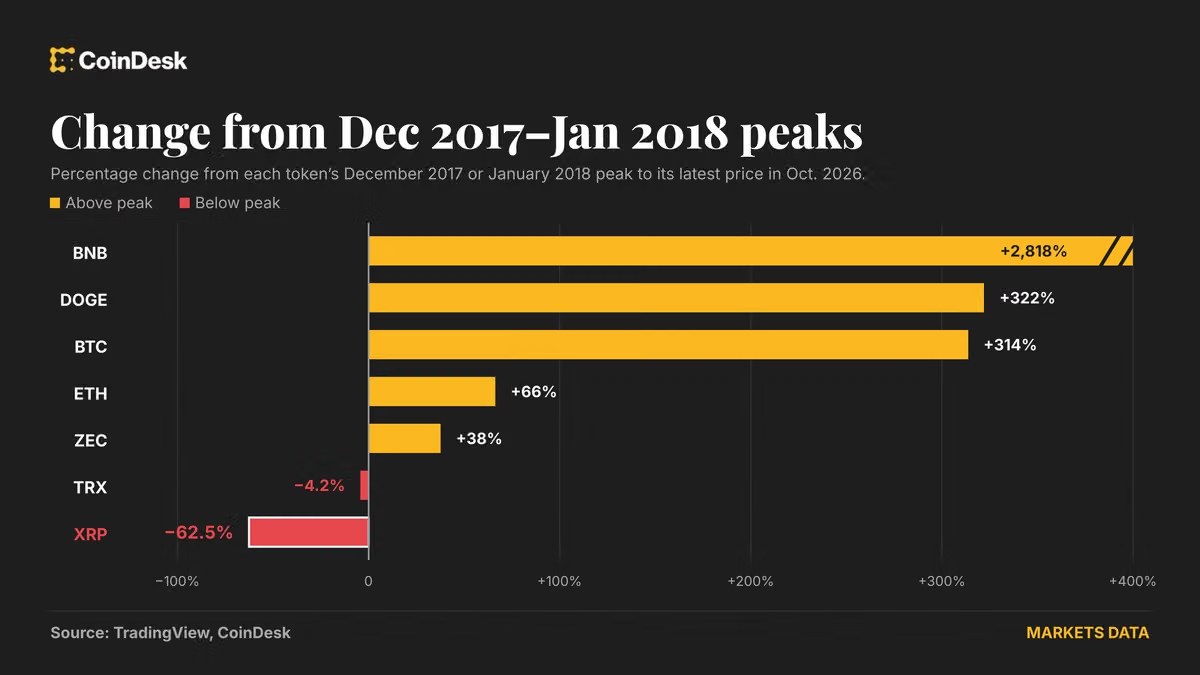
XRP remains below its 2017-cycle high while bitcoin, ether and other major tokens have surged, enriching their holders.
- XRP trades around $1.33, about 62.5% below its January 2018 peak, while Bitcoin, Ether and several other major cryptocurrencies have surpassed their previous highs.
- Analysts attribute XRP’s lagging price partly to a sharp increase in circulating supply, weak fund inflows and declining trading activity and network use.
- Ripple’s focus on payments, XRP’s limited exposure to popular crypto sectors and years of regulatory uncertainty from the S.E.C. case have also weighed on demand.
Holding is widely touted as a great way to build wealth in the crypto market, but it hasn't worked for every coin.
Take XRP (XRP), the payments-focused cryptocurrency native to the XRP Ledger and the world’s fifth-largest digital asset by market value.
The token is still trading well below its 2017 cycle high, while most other major cryptocurrencies have climbed far above theirs. In 2017, crypto broke into the mainstream, pulling in new users and investors during the frenzied run that carried into the first week or two of 2018.
XRP currently trades around $1.33, down 62.5% from its early January 2018 peak of $3.55. In other words, an XRP buyer from that peak is still underwater nearly nine years later. (XRP did briefly top its old high, reaching $3.66 in July 2025 before crashing.)
Bitcoin, ether and many other tokens have pulled back sharply from their 2025 peaks, yet remain far above their 2017 highs.
Too many coins
"Circulating supply grew 63%, from 38.7B in 2017 to 63.1B, while XRP's total market value fell only about 3%," Nicolai Sondergaard, senior research analyst at analytics firm Nansen, told CoinDesk. "More XRP in circulation means each token represents a smaller share of roughly the same total value."
Circulating supply is the number of coins on the market, and as it grows, each coin represents a smaller share of the total.
Oliver Carding, head of marketing at Tesseract Group, says XRP looks better when measured by total value instead of price.
"On value, XRP recovered," he said. "About 63% more XRP is in circulation than at that peak, so the same circulating market capitalization would mean a price roughly 39% lower."
Tesseract is an institutional digital asset management firm that manages over $500 million in assets under management.
Weaker demand
U.S.-listed exchange-traded funds, or ETFs, have opened the door for institutional investors to take exposure to digital assets. While bitcoin and ether funds have pulled in billions, XRP funds have lagged big time.
"ETF uptake has also been muted relative to $BTC and $ETH," said Paul Howard, senior director at market-making firm Wincent.
To date, XRP funds have pulled in just $1.80 billion in investor money since debuting nearly a year ago, according to data source SoSoValue. Bitcoin ETFs often attract over $1 billion in investor money in a single day.
Nansen's data also shows trading activity has weakened, with XRP spot volume down 53.5%, perpetual futures volume down 44%, and active addresses down 10.7%.
Ripple's focus
Ripple, the payments company closely tied to XRP, has focused on cross-border payments rather than chasing sectors such as DeFi, AI, and memecoins, which have attracted greater capital flows and deeper integration with traditional finance.
"Ripple, meanwhile, has been working hard to build payment infrastructure, RLUSD and trade financing products around the usage of the ledger and coin, and this has taken focus from just core XRP," Howard said.
"The role of DeFi for investment into ETH, SOL and HYPE has also been a new narrative which $XRP has not focused on," Howard said.
The SEC case
Ripple’s legal fight with U.S. regulators also held XRP back.
The Securities and Exchange Commission sued Ripple and two of its executives in December 2020, saying the company had raised about $1.3 billion by selling XRP without registering it as a security.
A federal judge ruled in 2023 that XRP sales on public exchanges were not securities offerings, but that sales to institutional investors were. In 2024, Ripple was ordered to pay a $125 million penalty. The case ended in August 2025, when both sides dropped their appeals.
Carding said the prolonged regulatory uncertainty helps explain why the token missed its old high during the 2021 crypto bull run, when Coinbase suspended trading.
“The SEC case helps explain why XRP did not revisit its 2018 high in 2021, when Coinbase suspended trading, but the appeals were dropped in August 2025 with XRP above $3,” Carding said. “Since then, XRP is down about 59%, against 32% for bitcoin and 44% for ether, and its circulating market capitalisation is down about 56%.”
Not the only laggard
XRP isn't the only coin trading below its early 2018 highs.
"On price, six of the other nine assets in the January 2018 top ten are further below their levels of that week," Carding said.
For those watching XRP, Carding has a suggestion.
"What I would watch is XRP against bitcoin, alongside net monthly distribution after re-escrow and changes in fund holdings," he said. "Relative weakness that persists as distribution slows would point to weaker demand."
In plain English, Carding is watching whether XRP underperforms bitcoin even as fewer new XRP tokens enter the market through Ripple’s escrow releases. If supply growth slows but XRP still lags bitcoin, it would suggest that investor demand for XRP is weakening.
Diversified RWA stablecoins sustain 5-7% yield from real credit as crypto funding compresses to ~4%. GENIUS pushes yield off-chain; TAM grows to $4B in 3 years.