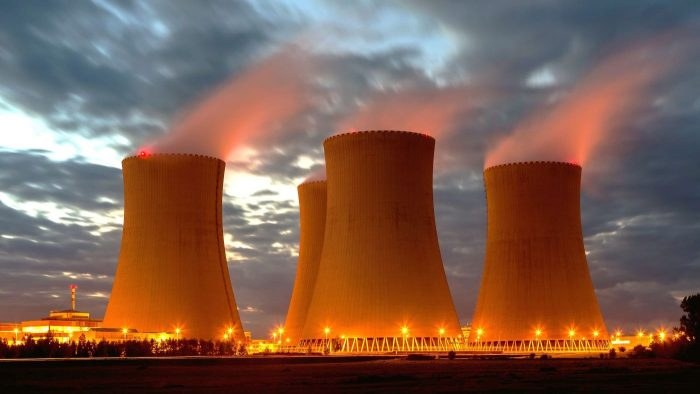
The Department of Energy (DOE) has narrowed the competition for its proposed Nuclear Lifecycle Innovation Campuses (NLICs) to five states: Utah, Tennessee, Oklahoma, Louisiana, and Idaho. The selection advances an effort that could create new investment and contracting opportunities across nearly every part of the nuclear value chain.
The biggest potential beneficiaries are not limited to reactor developers. Fuel suppliers, enrichment companies, manufacturers, and instrumentation providers could all participate. Companies with existing relationships in the five states may have an especially valuable head start.
Key Takeaways
- DOE selected five initial contenders after reviewing 28 applications from 26 states. The five states have signed memorandums of understanding to discuss potential hosting agreements.
- The proposed campuses could support enrichment, fuel fabrication, used-fuel recycling, waste management, reactors, manufacturing, power generation, and data centers.
- DOE estimates that the campuses could attract up to $50 billion in capital investment, generate as much as $10 billion in state and local tax revenue, and create nearly 25,000 jobs.
DOE Has Moved From Competition to Negotiation
The DOE introduced the NLIC concept earlier this year as a series of voluntary federal-state partnerships designed to rebuild the domestic nuclear fuel cycle. The agency said the campuses could include uranium enrichment, fuel fabrication, used-fuel reprocessing, recycling, and waste disposition. Depending on state priorities, they could also host advanced reactors, manufacturing facilities, power generation, and co-located data centers.
See more: Companies Set to Win as States Vie to Host Nuclear Campuses
DOE has now selected five initial contenders and signed memorandums of understanding (MOU) with each state to explore sighting potential NLICs in those states. The negotiations give states and companies an opportunity to assemble potential projects, financing structures, sites, infrastructure, and supply-chain partnerships.
Fuel companies such as Cameco (CCJ) and Centrus Energy (LEU) could address material and enrichment needs. BWX Technologies (BWXT), Curtiss-Wright (CW), Flowserve (FLS), and Mirion Technologies (MIR) represent different parts of the component, equipment, and instrumentation chain. Fluor (FLR) and Amentum (AMTM) bring engineering, construction, and nuclear-site management capabilities.
The result could be a multi-year contracting pipeline spread across the nuclear industry rather than a single award captured by one reactor company.
Utah Brings Fuel Materials and Waste Expertise
Westinghouse (49% owned by Cameco (CCJ)) already maintains multiple Utah locations, including its Western Zirconium operation in Ogden. This existing industrial footprint could give Westinghouse an advantage if a Utah campus includes fuel materials, fabrication, or component production.
Terrestrial Energy (IMSR) has an MOU with Salt Lake City-based EnergySolutions (private) to evaluate EnergySolutions-owned sites for Integral Molten Salt Reactor plants. EnergySolutions’ waste operations and licensed disposal facility in Clive create a natural connection between advanced reactors and the back end of the fuel cycle.
Tennessee Is Building an Advanced Fuel Cluster
Oklo (OKLO) has announced plans for an advanced fuel center in Oak Ridge. The proposed investment could total $1.68 billion, with an initial facility recycling used nuclear fuel into material for fast reactors such as Oklo’s Aurora powerhouse.
NANO Nuclear Energy (NNE) has an indirect Tennessee connection through LIS Technologies (private). NANO invested $2 million in LIST and entered a strategic collaboration with the company. LIST separately plans a $1.38 billion Oak Ridge enrichment facility, giving NANO potential exposure to Tennessee’s growing fuel ecosystem.
Oklahoma Offers a Greenfield Opportunity
Oklahoma lacks the established private nuclear-company footprint found in Tennessee or Idaho. That could make it the clearest greenfield opportunity for reactor developers and fuel companies seeking a new regional foothold.
The state does have institutional interest through the Grand River Dam Authority, which joined three Nebraska utilities in the Great Plains New Nuclear Consortium. The consortium is evaluating the build-out of nuclear capacity in the region.
Louisiana Adds Operating Plants and Manufacturing
Louisiana already has an established commercial nuclear base with Entergy (ETR) operating grid-scale reactors at the River Bend Station and Waterford plants. Turner Industries (private) has also announced nuclear fabrication facilities in New Iberia and Port Allen. Turner’s expansion is expected to create 1,000 jobs producing nuclear-grade piping and modular components.
Another potential pathway runs through Applied Atomics (private), which has secured rights for deploying the BWX Technologies (BWXT) mPower reactor. The mPower design from BWXT is a small modular reactor (SMR) engineered for powering data centers and critical loads without connecting to a national electric grid. Applied Atomics is working with the state of Louisiana to site some of their first facilities.
Idaho Already Resembles a Nuclear Innovation Campus
For decades, the state has hosted Idaho National Laboratories (INL), one of the country’s leading DOE facilities for nuclear energy research and development.
Oklo (OKLO) signed a DOE agreement supporting the construction and operation of its first Aurora reactor at INL. Its Idaho work also includes a facility intended to fabricate Aurora’s first fuel assemblies, a project that is well aligned with the integrated NLIC model.
Lightbridge (LTBR) is separately working with INL to fabricate and irradiate experimental advanced-fuel materials. An Idaho campus could provide additional infrastructure for fuel qualification and eventual commercialization.
NUKZX Tracks the Broader Opportunity
The NLIC initiative illustrates why nuclear investment opportunities extend beyond uranium mining or choosing a single reactor developer. Building just one of the NLICs would require multiple companies across the nuclear value chain.
The VettaFi Nuclear Renaissance Index (NUKZX) is designed around four segments from the nuclear value chain: Advanced Reactors, Utilities, Construction & Services, and Fuel. Those categories closely map to the potential NLIC opportunity. That breadth also reduces the need for investors to predict which state, reactor design, or fuel technology will ultimately emerge as the biggest winner.
NUKZX serves as the underlying index for the Range Nuclear Renaissance Index ETF (NUKZ).
Related Research:
Companies Set to Win as States Vie to Host Nuclear Campuses
The Consortium Fueling the Nuclear Renaissance
From Cold War Liability to Advanced Nuclear Fuel
Looking for nuclear insights in your inbox? Subscribe here to keep a pulse on nuclear investing through our weekly research.
For more news, information, and analysis, visit the Nuclear Energy Content Hub.
vettafi.com is owned by VettaFi LLC (“VettaFi”). VettaFi is the index provider for NUKZ, for which it receives an index licensing fee. However, NUKZ is not issued, sponsored, endorsed, or sold by VettaFi. VettaFi has no obligation or liability in connection with the issuance, administration, marketing, or trading of NUKZ.