One year after a flash crash wiped out billions in leveraged crypto bets, traders have better tools to spot risks. But the forces behind the selloff remain.
- Nearly a year after bitcoin's October 2025 crash triggered $19 billion in liquidations, analysts warn that the risks behind the selloff remain.
- Leveraged trading and crowded bets continue to drive bitcoin's short-term price moves, even as traders gain better tools to track market risks.
- Experts urge traders to avoid leverage, monitor market sentiment and derivatives data and consider self-custody to protect their holdings.
The October 2025 crypto crash exposed the dangers of leverage and crowded bets. A year later, analysts say those risks remain.
Nearly a year after one of crypto's most violent selloffs, the question hanging over the market is whether traders have learned enough to prevent another one.
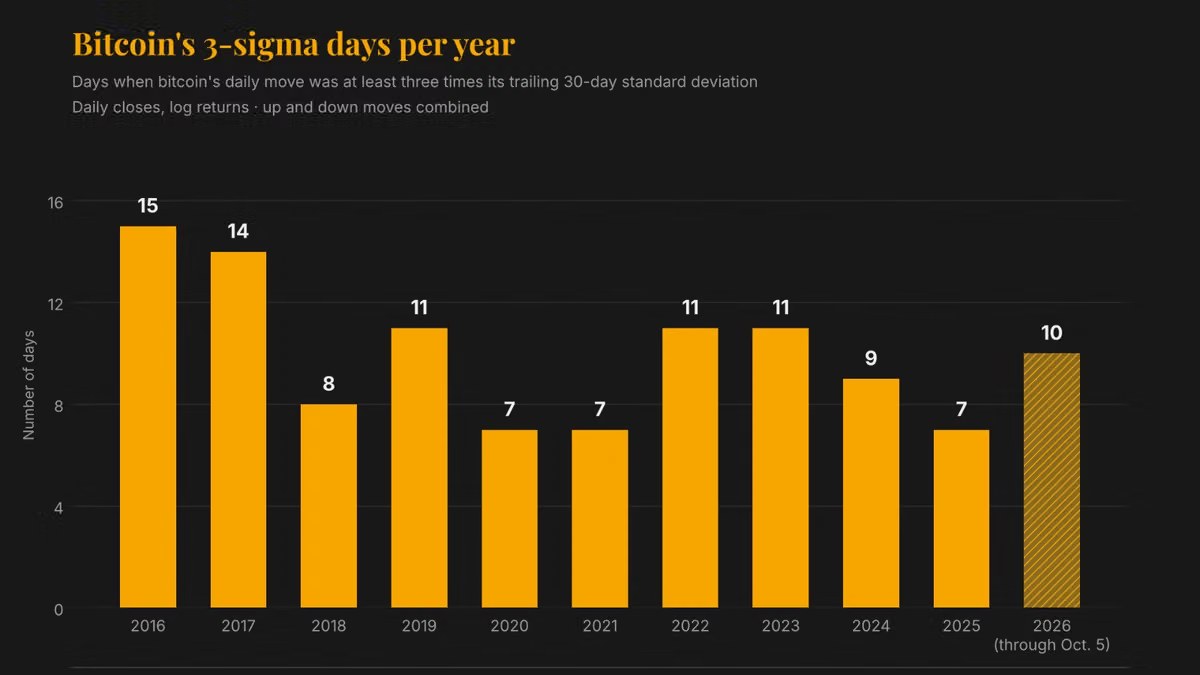
Just days after hitting a record high above $126,000O, on October 10, 2025, bitcoin
But while the selloff shook confidence in the market, the conditions that helped cause it haven't gone away.
"It just was a very quick and violent market top that we did not expect," said Mark Connors of Risk Dimensions, who previously ran a hedge fund positioning product at Credit Suisse.
"Positioning was important then, and it's important today," he said in an interview.
Coming into the crash, open interest was near historic highs, and traders had piled into bullish positions, betting that bitcoin would follow its familiar four-year cycle toward fresh records.
"People were keenly aware, like me, they were bulled up because it was 'go' time," Connors said. "We were going to go to that $250,000 to $300,000, $400,000 level using previous cycles."
Instead, the market turned against them.
"The movement was obviously not onchain data. I mean, it was all derivatives," he said. "So paper bitcoin again is alive and well and governs the near term." The lesson, he argues, is that bitcoin's price can be driven as much by leveraged bets as by demand for the asset itself.
That hasn't changed much in the past year. Perpetual futures, which allow traders to bet on price moves without owning bitcoin, remain a major part of crypto trading. Exchanges also have strong financial incentives to keep offering leveraged products. Still, traders may be better equipped to navigate the risks.
"The data is getting better at defining what the market structure is," Connors argued, pointing to improved visibility into order books and positioning. "More information means greater certainty, less volatility."
Chris Sullivan, co-founder of Hyperion Decimus, said traders can take steps to protect themselves from the kind of losses seen last October.
His advice starts with avoiding leverage and keeping a close eye on open interest, funding rates and market sentiment. Open interest tracks the number of outstanding derivatives contracts, while funding rates reflect the cost of holding positions in perpetual futures. Together, they can help traders spot when the market is leaning too far in one direction.
Sullivan also urged patience when those measures reach extremes, whether traders are betting on rising or falling prices. For long-term bitcoin holders, he recommended buying the asset, moving it off exchanges and holding it in self-custody rather than leaving it with a trading platform.
That doesn't mean another crash is off the table. "There's still a chance that you can have an October 10th for sure," Connors warned. "The levered products have not gone away."
The crash also challenged one of bitcoin's most widely held assumptions: that its four-year cycle, tied to the halving of mining rewards, could serve as a reliable guide to future prices.
"We all, including me, got caught offside," Connors said. "The four-year cycle is not dead; it has changed, and we can't rely on it for as much signal as we have in the past." He now believes economic and political forces may play a larger role in bitcoin's cycles than investors once thought. Meanwhile, the growth of institutional investment products has done little to displace the derivatives market's influence over short-term prices.
For all the changes since October 2025, Connors sees one important distinction between the crash and its aftermath. "I think a year later, we learned to be more attentive to market structure," he said.
And despite the damage, bitcoin's market survived. "The market did bend; it didn't break."
Diversified RWA stablecoins sustain 5-7% yield from real credit as crypto funding compresses to ~4%. GENIUS pushes yield off-chain; TAM grows to $4B in 3 years.