In brief
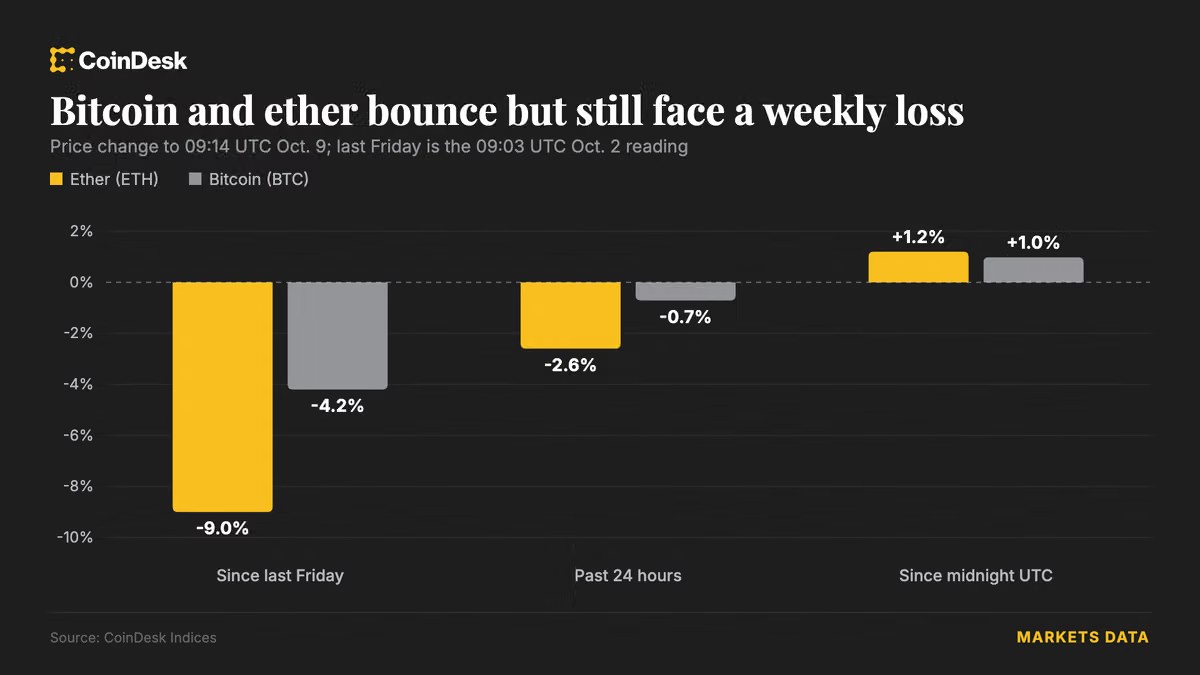
- Bitcoin has dropped 4.1% this week, after U.S. spot BTC ETFs shed $484.9 million Wednesday.
- The slide comes in October, which is historically a green month for the leading cryptocurrency.
- Experts warn that Bitcoin could continue to stoop, testing support levels as low as $72,000.
Bitcoin has been in the red since October started, a month historically green for the leading cryptocurrency—often referred to as "Uptober." Experts warn not to treat October as a reliable bottom for Bitcoin, and predict there could be more bleeding ahead.
Per CoinGecko data, Bitcoin hit lows of $80,427 in the past week, and is currently trading at just under $83,000, down 4.1% over the past seven days. On Myriad, a prediction market owned by Decrypt's parent company Dastan, users put a 79% chance on Bitcoin ending the week above $82,000, and just a 28% chance of it topping $84,000.
"From a market-structure perspective, the $83,000 region remains an interesting level," Luke Deans, Senior Research Associate at Bitwise Europe, told Decrypt. "This area combines the average ETF cost basis with the prior technical higher-high threshold and has been tested repeatedly over recent weeks."
Where is support?
Bitcoin fell below $83,000 early on Thursday morning and is currently attempting to recover. Deans said the reaction to this will be "informative," as if it struggles to recover, then lower structural support targets should be considered.
Ananda Banerjee, Founder and Principal Quantitative Researcher at analysis firm Charlie Quant Lab, told Decrypt that he sees strongest support at $77,000. This is according to on-chain metrics, he said, which show a notable cluster of the Bitcoin supply was bought at this level. Deans agrees that the average acquisition price of active investors, or the True Market Mean, is near $77,000.
However, Deans also sees lower support at $74,000 with the Short-Term Holder Cost Basis, which represents the average acquisition price of newer market participants. The 200-day moving average also sits at $72,000, which he said provides an independent technical reference alongside the on-chain measures.
"Through this lens, Bitcoin could fall materially from current levels and still remain within what we would consider a constructive risk-on structure," Deans told Decrypt. "A move into the $72,000 to $77,000 region would represent a strong retest of the broader transition zone."
If that area is successfully defended, he said, then a range which previously acted as resistance for Bitcoin movements will be turned into support—which would be a positive signal. That said, failing to defend that zone could "impair current market structure."
Still, Bitcoin tested a move above $87,000 at the start of the week, albeit unsuccessfully. The failure was driven "mainly by futures positioning rather than spot demand," Bitfinex analysts told Decrypt. "Spot demand remains the missing piece," they added, noting that U.S. spot Bitcoin ETFs took in $241.1 million in the week of September 28 to October 2, against $2.39 billion the week before. "The average ETF investor is back at breakeven for the first time since January, a level at which inflows have historically been slow," they said.
Can-Luca Köymen, Investment Strategist at Sygnum Bank, also told Decrypt that low spot volume is stunting Bitcoin's price action.
Bitfinex analysts believe that Bitcoin's consolidation range is between $84,000 and its yearly open of $87,722. The analysts said that September CPI on October 14 could put an end to that range, alongside ETF flows picking up.
Bitcoin ETFs lost $484.9 million on Wednesday, the worst single-day outflow since June 25, according to Decrypt's ETF tracker. BlackRock's IBIT took the biggest hit at $207.7 million, with Fidelity's FBTC next at $105.1 million. Experts believe this needs to reverse for a successful Uptober—but with the funds shedding a further $244 million Thursday, the direction of travel is still downwards.
Is Uptober cancelled?
So, is Uptober over? Most experts that Decrypt spoke to were hesitant to declare Uptober cancelled over a single week of red action. Still, they warned against basing investment decisions based on a hyped up month rather than fundamentals.
"Historical evidence supports October strength," Jake Kennis, Senior Research Analyst at Nansen, told Decrypt. "Bitcoin has posted a median October return of roughly 14% since 2013, with 10 of the past 13 Octobers finishing positive."
"But ultimately liquidity, positioning, macro conditions, and underlying demand are more important drivers than any specific date," he added.