The Bank of England has raised interest rates for the first time in three years and warned of another increase to come to combat rising inflation unleashed by the Iran war.
Eight members of the Bank’s monetary policy committee (MPC) voted for the move, which takes the base rate from 3.75% to 4%. The ninth member, Catherine Mann, preferred a more dramatic half-point increase.
The Middle East conflict has pushed oil prices persistently above $100 in recent months, as hopes have evaporated of a deal that could reopen the key strait of Hormuz.
As a result, the Bank now expects UK inflation to rise to 4.9% in the middle of next year – up from 3.2% in its last economic forecast, in July. Inflation hit 3.5% in September, as measured on the consumer prices index.
The decision, which will hit mortgage borrowers, comes a week after John Healey used his first budget to promise “breathing space” for hard-pressed consumers. Echoing the Office for Budget Responsibility’s gloomy forecasts for living standards, the MPC expects real post-tax income to fall this year and next.
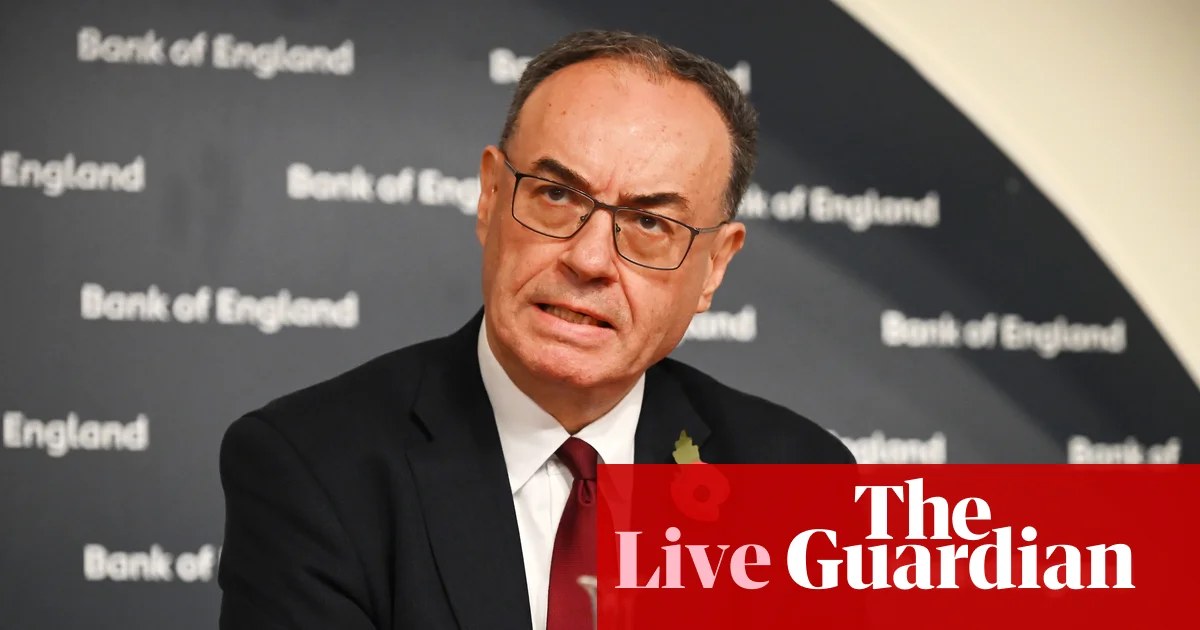
Andrew Bailey, the Bank’s governor, told reporters in London:
Today’s increase should not be seen as the first in an inevitable long sequence of hikes. That is not inevitable.
But unless the conflict in the Middle East is resolved, neither does it seem likely to be the last increase.
The tech-heavy US Nasdaq share index is on track for its worst day in 18 months after slumping by up to 5% on Thursday amid growing signs that the artificial intelligence industry will face tougher regulation following this week’s midterm elections.
Amid widespread losses on Wall Street, the Nasdaq composite tumbled into ‘correction territory’ – more than 10% below its recent record high. The index was heading for its biggest one-day fall since April 2025 when Donald Trump announced his ‘liberation day’ tariffs on US trading partners.
Worries over massive AI spending gripped the New York stock market, and rippled out to other bourses worldwide, as investors anticipated tougher scrutiny of data-centre expansion plans.
Chip stocks led the slump, with memory maker SanDisk tumbling by 19% and hard drive maker WesternDigital falling by 16.5%.
“After initially seeming to shrug off concerns about what a Democrat blue wave in the midterm elections might mean for the AI trade, panic set in on Thursday,” says AJ Bell head of financial analysis Danni Hewson.
“The Nasdaq lost more than $1.8 trillion worth of value in intraday trading to enter correction territory, down at least 10% from the most recent highs attained in early October. Investors are fearful of a regulatory backlash against the AI sector from newly elected Democratic lawmakers.”
Wall Street’s ‘fear index’, the VIX, has jumped by 40% to its highest levels since the early weeks of the Iran war, in a sign of rising market volatility.
The slump on Wall Street has rippled across to the London stock market too.
The FTSE100 share index has closed for the night, down 46 points or 0.4% at 10,782 points.
Earlier this morning the ‘Footsie’ had been up over 100 points.
Susannah Streeter, chief investment strategist at Wealth Club, says:
‘Fresh panic over the AI trade has hit Wall Street hard, with a steep sell-off on the Nasdaq, and the S&P 500 sending shockwaves rippling to other markets. Fears that the vast sums poured into AI infrastructure may not deliver the returns investors have been banking on are now colliding with the prospect of a sharp slowdown in data centre construction. Chip stocks have been the hardest hit with AMD down 13%, Nvidia falling around 7% and Intel another 5.5%.
The contagion is spreading - the FTSE 100, which had been on the front foot and is far less exposed to big tech, has now erased its earlier gains and turned negative. Even a tech-lite index with defensive appeal hasn’t been able to shrug off this big case of the jitters.
Back on Wall Street, the Dow Jones industrial average (DJIA) has slumped by 2.5%, or 1,346 points, as shares retreat sharply.
Both the S&P500 share index and the tech-focused Nasdaq has hit their lowest levels since late July, and on track for their biggest one-day drop in five months.
Chip giant Nvidia is leading the selloff on the DJIA, down 8%, followed by GoldmanSachs which has dropped by 6.5%.
Oxford Economics: Hawkish MPC puts a December hike on the table
A December hike in UK interest rates is now “on the table”, argues consultancy Oxford Economics, following today’s rise.
OxfordEconomics believes that December’s Monetary Policy Committee meeting “looks like a coin flip”, with oil and natural gas prices set to be the decisive factor.
Their chief UK economist AndrewGoodwin reckons the committee’s messaging was more hawkish than before.
“Higher energy futures prices and more evidence of domestic resilience both increase the risk of second-round effects emerging.
The degree of inflationary pressure already in the system means another hike in December or February is likely.”
Tesla and SpaceX shares slide as midterms pain continues
Oil and gas aren’t the only volatile elements in the markets today, following the events of the last 48 hours.
Over on Wall Street, Elon Musk’s businesses are being hit in the aftermath of the midterm election results.
Shares in Tesla and SpaceX are both down around 9% in early trading, adding to losses yesterday that wiped billions of dollars off both company’s valuation.
The midterms have been something of a disaster for Musk.
He contributed at least $446m to Republican-aligned Super Pacs and groups over the course of the elections, specifically targeting several key Senate races in an effort to help the Trump administration retain Republican control of Congress – and then watched the Democrats rack up a series of election wins.
Voters across the US also voted for bans or restrictions on datacentre development, in a backlash against AI.
Several economists are arguing that today’s rise in UK interest rates is not the start of a long cycle of rate hikes.
Sanjay Raja, Deutsche Bank’s chief UK economist, says today’s move is an “insurance policy” against the danger ofsecond-round effects (a wage-price spiral), arguing:
Today’s hike merely adds a dose of policy restriction to an already restrictive policy stance. Moreover, with financial conditions having tightened materially since March, the case to go much further isn’t as strong as it may have been in the Bank’s previous hiking cycle back in 2022.
With signs of second-round effects remaining minimal at this juncture, we retain our view for one more hike with Bank Rate peaking at 4.25%. And perhaps the bigger question from today’s decision is whether the next hike comes in December or February. There is a clear risk that the MPC could go earlier – this will be something to watch in the coming weeks and will likely be determined by forthcoming inflation outturns as well as developments in the Middle East (with the last 48 hours delivering some good news on energy price expectations).
Modupe Adegbembo, economist at investment bank Jefferies, believes another hike is likely, but not a foregone conclusion, telling clients:
February is our base case, but the MPC looks willing to pause if the backdrop improves materially.
A resolution to the conflict or a further meaningful stabilisation in energy prices would reduce the need for another move, particularly if second-round effects remain limited. So we think the bias is towards another hike in February, but it remains conditional on the energy shock and evidence of persistence.
Daniel Siluk, head of global short duration & liquidity at JanusHendersonInvestors, is also cautious about interpreting today’s decision as the beginning of a prolonged hiking cycle.
The energy shock is lifting headline inflation, but there remains relatively limited evidence that it is becoming embedded in broader wages and prices. At the same time, higher energy bills, elevated mortgage rates and tighter financial conditions are increasingly weighing on household purchasing power and should ultimately slow demand. Andrew Bailey was careful to stress that today’s move should not be viewed as the first in a sequence of increases. Our view is that the Bank is effectively buying some insurance against second-round inflation effects and protecting its inflation-fighting credibility.
One further increase looks increasingly plausible, but the bigger question for markets is whether the considerably longer tightening cycle currently reflected in the curve will ultimately be delivered.
Bailey: Burnham right to see opportunity to end Iran and Ukraine wars after midterms
Q: You say the best thing that can happen is, is to resolve the conflict in the Middle East. Given the events of the last 48 hours, would you make that plea directly to US President Donald Trump or the Republican Party for the sake of the UK economy or global economy? (asks Hannah Brenton of Politico).
Andrew Bailey replies that prime minister Andy Burnham put this pont very clearly in the last 24 hours, speaking at the Commonwealth summit [where the PM said the midterm election results are an “opportunity” to focus on ending the Iran war].
Bailey says he supports Burnham on this issue, explaining:
I mean, he also made the same point about Russia’s illegal invasion of Ukraine.
This is absolutely critically important….
I’m very much speaking in the same vein and very much support what he said.
Q: How mindful of you about the NEET crisis, as you mentionead earlier that lower-paid people who are struggling to find work will be hit the hardest by inflation?
AndrewBailey replies that the Bank is “very conscious” that there is a section of the population on low pay and section of population that isn’t able to find work.
We’re very conscious of the impact that inflation, particularly energy price inflation or inflation that originates in energy prices, has, so we are very conscious of that.
Q: Under your central projection, inflation returns target in the third quarter of 2028. It will then have been above the 2% target for for all but one of the previous seven years – what does that say about the BoE’s credibility as an inflation-targeting central bank?
Bailey blames the series of shocks that have hit the UK economy, arguing that few people would have predicted in 2020 that we would today be living in a world where there is a major war in the Middle East and in Europe at the same time.
Q: Governor, you said before the budget that fiscal policy needed to be directed towards stability, and be seen by markets as credible – did the chancellor get the message?
Andrew Bailey bristles at the suggestion he was trying to influence John Healey’s first budget, saying:
I’m very careful what I say on fiscal policy. I said nothing on the budget whatsoever.
Bailey then deploys the BoE’s monetary policy remit in his defence, saying it gives the Bank the objective of supporting the economic policies of the government of the day, including the fiscal framework.
I do support it. So there’s nothing more to it than that, really. It’s not a controversial thing to say at all. Really.
Asked about UK-EU ties, Bailey bangs drum for trade and openness
Q: The government has talked about wanting to open a new conversation about the UK’s future relationship with the European Union – Do you welcome that conversation? Do you expect to contribute to it? And is the Bank’s broad view that a closer relationship with the EU will be positive for growth? (my colleague Heather Stewart asks).
AndrewBailey reminds the press conference that he has a long record of not taking a view on Brexit, per se.
But he then argues the merits of greater trade and openness, telling reporters:
I am in favour of trade and openness because it actually is a source of growth and economies. It is a source of productivity growth.
We learn this from Adam Smith and ever since and so, anything that is done to enhance and support the development of sustainable trade and openness is something I would encourage.
Q: Does the Bank see any risks from the strength of wage growth in the public sector?
[Reminder: earnings growth is running at 6.3% in the public sector and 3.0% in the private sector, according to the latest data].
Deputy governor ClareLombardelli says the Bank does not see public sector pay as a particular risk, adding:
Obviously, we’ve had the decision around the living wage – our agents tell us it is in line with what people were expecting or potentially a little below it. So we don’t think that will be an additional pressure.